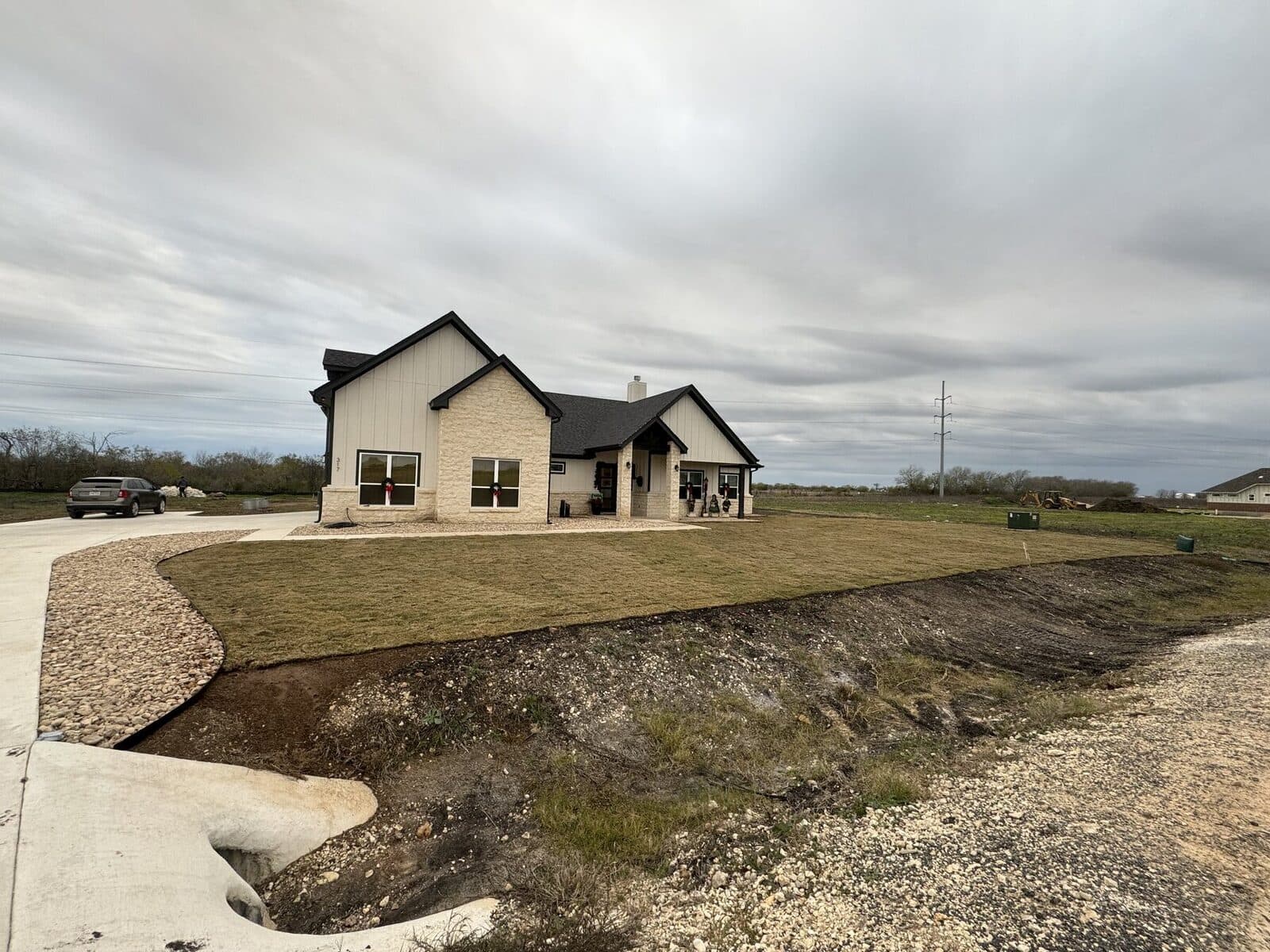
Anyone who has put a shovel in the ground between Seguin and Stockdale knows what it feels like. Wet, it is heavy and sticky and will not break apart. Dry, it goes hard enough to bend a spade, and the cracks open wide enough to lose a hose fitting in. That behaviour is the single most useful thing to understand about landscaping here, because it explains most of the plants that fail.
Why clay kills plants that should live
Clay particles are small and pack tightly, which leaves very little air in the soil and lets water move through slowly. Two problems follow from that. After a heavy rain the ground stays saturated for days, and roots sitting in airless wet soil rot. Then in August the same ground dries and contracts so hard it pulls away from roots and from foundations.
So a plant here is not usually killed by drought or by rain. It is killed by both, in the same year, in ground that swings between the two extremes faster than the roots can adapt.
The bathtub mistake
The common instinct is to dig a generous hole and backfill it with bagged garden soil. In clay this is actively harmful. You have dug a bowl of slow-draining material and filled it with something that drains fast. Water runs into it, reaches the clay wall, and stops. The plant sits in a bathtub with no drain.
The better approach is to amend broadly and shallowly rather than deeply and narrowly. Improve the whole bed area, plant slightly high so the crown sits above the surrounding grade, and mulch to keep the moisture swing at the surface from being so violent. Roots will move outward into native soil, which is where they need to end up anyway.
Choose for the soil, not the catalogue
The most reliable way to win here is to plant things that were already going to be fine. Plenty of tough, good-looking material handles heavy soil and long dry spells without complaint, and it stops being a maintenance argument every summer.
- Look for plants described as tolerant of heavy or poorly drained soil, not just drought tolerant. Those are different traits and a plant can have one without the other.
- Give new plantings a full establishment season of consistent water. Drought tolerance is what a mature root system does, not what a plant does the month it goes in the ground.
- Plant into the shoulder seasons where possible. Roots make progress in cool soil, and a plant that goes in during a Texas August is spending everything it has on survival.
- Mulch beds properly and keep it off the stems. It moderates soil temperature and slows the wet to dry swing that does the real damage.
Where the water goes matters as much as how much
On clay, water runs off before it soaks in, particularly on any slope and particularly when the ground is already dry and crusted. A long deep soak does more than frequent short cycles, which mostly wet the top inch and evaporate.
This is also why grading and drainage belong at the start of a job rather than the end. Ground that sheds water toward the house, or holds it in a low corner, will keep killing plants regardless of what gets planted there. Fixing the way water moves across a property is not glamorous work and it is usually the difference between a landscape that holds up and one that gets replaced in pieces.